
he benefits of compression boots for marathon runners can be difficult to judge because product claims often go beyond the evidence. Tired legs can make any recovery shortcut appealing, especially during peak training. I suggest treating compression boots as an optional comfort tool, then evaluating whether they solve a specific recovery task.
Compression boots may provide temporary relief from perceived leg heaviness, soreness, or discomfort after long runs. They can also create a convenient recovery routine. However, current evidence does not prove that consumer compression boots prevent injuries, accelerate healing, or improve marathon times. Results depend on the runner, device, pressure, fit, and recovery goal.
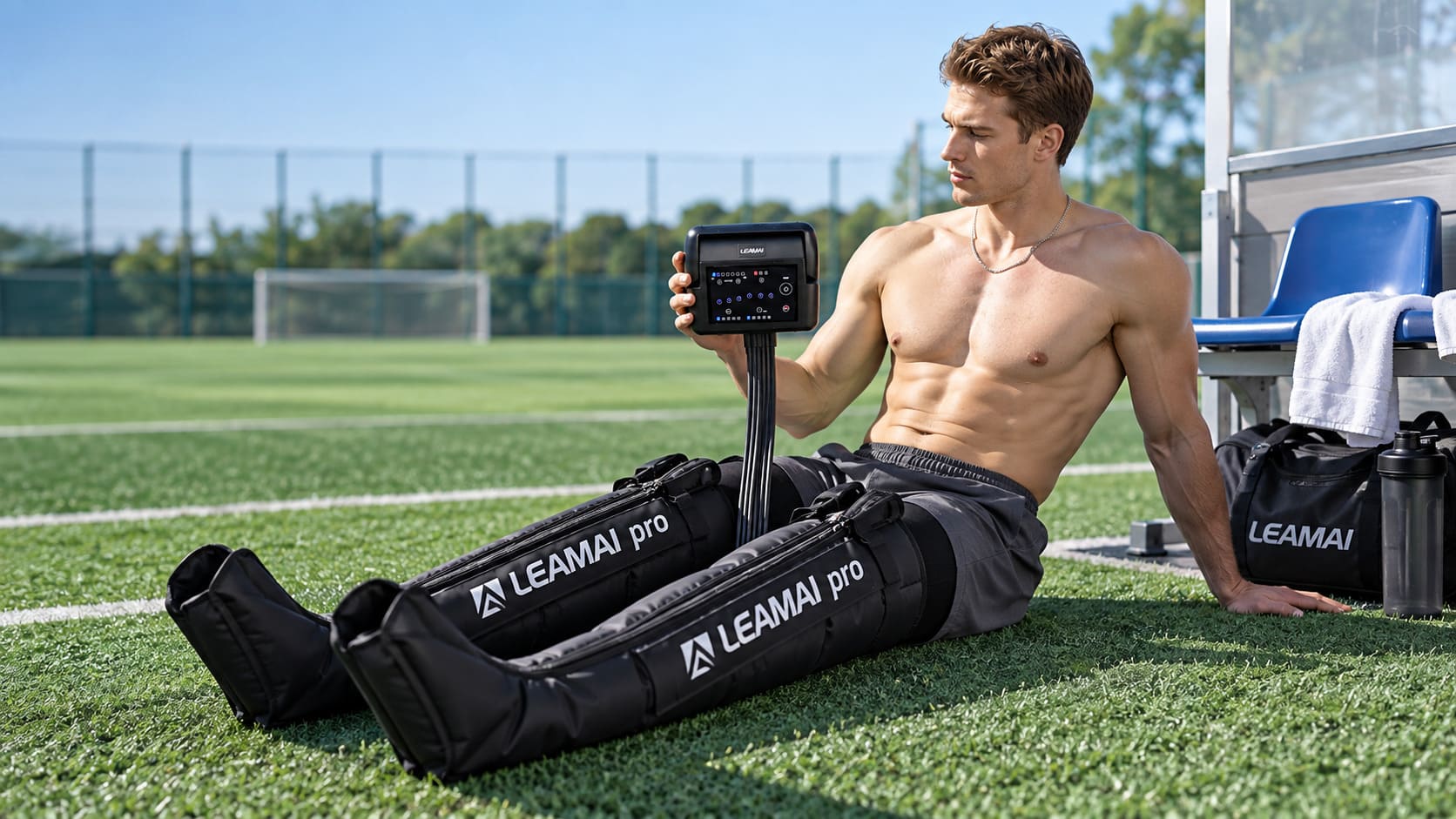
I have heard encouraging feedback from several runners, but those conversations were not systematic research. I use that feedback to understand comfort preferences and practical concerns. I do not use it to prove physiological benefits. That distinction helps me judge these products more realistically.
What Are the Real Benefits of Compression Boots for Marathon Runners?
Marathon training can leave a runner’s legs feeling heavy and uncomfortable. That feeling often creates pressure to find a faster recovery method. Compression boots may help with short-term comfort, but I would first define the exact job that the boots need to perform.
The most realistic benefits of compression boots for marathon runners are temporary comfort, reduced perception of leg heaviness, and a structured way to rest after training. Some runners also find the pulsing pressure relaxing. These outcomes are personal and should not be confused with guaranteed muscle repair, injury prevention, or better race performance.
I start with the recovery task
Before I compare brands or pressure specifications, I ask a simple question:
> What specific problem should the boots solve?
A runner may want:
- A relaxing routine after a long training run
- Temporary relief from perceived heaviness
- A hands-free alternative to self-massage
- Adjustable pressure that feels comfortable
- A portable recovery option during race travel
- A reason to sit down and rest for 20 to 30 minutes
These are reasonable use cases. They are also easier to evaluate than broad claims such as “recover faster.”
For example, a runner can compare how their legs feel before and after several sessions. They can also consider whether they actually use the boots consistently. If the boots remain in a cupboard because they are difficult to clean, noisy, or uncomfortable, even a premium model has little practical value.
Comfort is useful, but it is not clinical proof
Runners I have spoken with often describe their legs as feeling “lighter” after a session. Some enjoy the sequential squeezing sensation. Others dislike pressure around the feet or calves. This feedback tells me that individual response varies significantly.
However, perceived comfort does not prove that the device:
- Repairs muscle tissue faster
- Removes metabolic waste
- Prevents delayed-onset muscle soreness
- Reduces the risk of running injuries
- Improves endurance adaptation
- Produces a faster half-marathon or marathon time
Those claims require controlled research. A pleasant session may still have value, but I keep that value within realistic limits.
I judge utility over several weeks
I would not evaluate compression boots after one exciting first session. Novel equipment often creates strong expectations. Instead, I would test them during several comparable training weeks.
A simple log can help:
| Evaluation point | What I would record |
|---|---|
| Training load | Distance, intensity, and terrain |
| Session timing | How soon the boots were used after running |
| Session duration | For example, 20 or 30 minutes |
| Pressure setting | Low, medium, or the device’s numbered level |
| Comfort | Comfortable, distracting, painful, or numb |
| Perceived heaviness | Rating before and after use |
| Next-day feeling | Better, unchanged, or worse |
| Practical use | Setup, noise, cleaning, and battery performance |
This log cannot create clinical evidence. However, it can show whether compression boots deserve a place in one runner’s routine.
Do Compression Boots for Marathon Runners Improve Recovery or Performance?
Recovery claims can sound scientific without clearly defining “recovery.” That ambiguity creates a problem. A runner may interpret a short-term improvement in comfort as proof of faster tissue repair or improved performance, even though those are different outcomes.
Research on intermittent pneumatic compression and exercise recovery has produced mixed, protocol-dependent findings. Some studies report changes in perceived soreness or selected recovery markers, while others find limited performance effects. I would not assume that medical pneumatic compression research applies directly to every consumer recovery boot or marathon runner.
I separate subjective and objective outcomes
A study can measure several different outcomes:
- Perceived soreness: A runner reports how sore their legs feel.
- Perceived recovery: A runner rates how ready they feel to train.
- Range of motion: A researcher measures joint movement.
- Blood-flow variables: A laboratory measures specific circulatory responses.
- Biochemical markers: A study tracks selected blood markers.
- Performance: A runner repeats a time trial, jump, or strength test.
- Injury rates: Researchers monitor injuries over a longer period.
A positive result in one category does not automatically prove a benefit in another. Less perceived soreness, for example, does not prove that damaged tissue has healed faster. It also does not guarantee improved race performance.
I recommend reviewing current research through sources such as the PubMed database on intermittent pneumatic compression and exercise recovery. I would check the study population, sample size, device, pressure, session length, and comparison group before applying a conclusion.
Medical devices and consumer recovery boots are not interchangeable
Hospitals use intermittent pneumatic compression systems for defined medical purposes, including certain situations involving blood-clot prevention. Those devices operate within clinical protocols and under professional supervision. The Cleveland Clinic overview of intermittent pneumatic compression devices explains this medical context.
A consumer recovery boot may use a similar inflation concept, but that similarity does not prove equal performance, suitability, or intended use. Differences may include:
- Pressure accuracy
- Chamber design
- Inflation sequence
- Garment fit
- Calibration
- Intended use
- Quality-control procedures
- Medical-device registration status
- Clinical supervision
I therefore avoid using hospital applications to justify broad athletic claims.
I consider the rest of the recovery plan
Compression boots should not displace basic recovery practices. A runner still needs an appropriate training plan, enough sleep, suitable nutrition, hydration, and sensible load management. Persistent problems also require professional assessment.
I see the boots as an accessory around those foundations. I do not see them as compensation for poor sleep, sudden mileage increases, or running through unresolved pain.
The likely value also changes by runner. Someone who enjoys the sensation and uses the system regularly may value it highly. Another runner may gain more practical benefit from spending the same budget on suitable footwear, coaching, nutrition advice, or physiotherapy.
Is Higher Pressure Better in Compression Boots for Marathon Runners?
Pressure numbers are easy to advertise, so buyers often compare the highest available setting. That comparison can be misleading. Excessive pressure may be uncomfortable, while a lower adjustable setting may fit the runner’s recovery task much better.
Higher pressure is not automatically more effective. The appropriate setting depends on comfort, fit, individual tolerance, device design, and professional guidance when relevant. A useful compression boot should provide controllable, repeatable pressure without causing pain, numbness, skin changes, or other concerning symptoms.
Pressure specifications need context
A pressure figure in millimetres of mercury, or mmHg, may look precise. However, the number alone does not describe the complete experience.
I would also examine:
- Pressure range: Can the runner start low and increase gradually?
- Number of adjustment levels: Are the steps small enough for practical control?
- Chamber sequence: Do the chambers inflate in a clear, consistent order?
- Zone control: Can the runner reduce or disable pressure in a sensitive area?
- Garment fit: Does the boot fit the foot, calf, knee, and thigh correctly?
- Pressure tolerance: Does the session remain comfortable from start to finish?
- Release function: Can pressure be stopped and released quickly?
- Consistency: Does the same setting feel repeatable across sessions?
Two systems with the same maximum pressure may feel very different because their chambers, garment geometry, and control algorithms differ.
Fit matters as much as the control unit
An oversized boot can position its chambers poorly. A boot that is too small may feel restrictive before inflation begins. I would check the manufacturer’s size chart against leg length and circumference rather than selecting a size based only on height.
I would also look for:
- Even closure along the leg
- No sharp folds in the fabric
- Enough room around the foot and calf
- Correct hose attachment
- Stable chamber positioning
- No concentrated pressure over a painful area
During a session, the runner should follow the product instructions. If the device causes pain, tingling, numbness, unusual colour changes, or worsening discomfort, I would stop using it and seek appropriate guidance.
I would not chase the strongest sensation
Some runners assume that a powerful squeeze means the device is working better. I do not use sensation as a dose-response test. More discomfort does not establish more recovery.
I prefer a conservative process:
- Read the complete instructions and warnings.
- Confirm that no relevant medical concern is present.
- Select the correct garment size.
- Begin with a low setting.
- Check comfort during the first few minutes.
- Stop if unusual or concerning symptoms appear.
- Increase pressure only when the instructions allow it and the setting remains comfortable.
A runner with a medical history, unexplained symptoms, or circulation concerns should ask a qualified healthcare professional to evaluate whether pneumatic compression is appropriate and what settings are suitable.
When Should Marathon Runners Avoid Compression Boots?
Not every post-run symptom is ordinary fatigue. Unusual swelling or pain can indicate a condition that should be assessed rather than compressed. Using recovery boots without understanding those warning signs could delay appropriate care.
A runner should avoid using compression boots over unexplained pain, suspected blood clots, acute infection, significant circulation problems, or other conditions listed in the product instructions. Sudden one-sided swelling, warmth, redness, chest pain, or breathlessness needs prompt medical attention rather than a home recovery session.
I distinguish normal fatigue from warning signs
Normal post-training fatigue can still be uncomfortable, but a runner should not assume that every symptom is caused by hard training. The UK National Health Service lists possible signs of deep vein thrombosis, or DVT, such as pain and swelling in one leg, warm skin, and red or darkened skin. Its DVT guidance also explains when emergency help may be needed.
I would seek urgent medical guidance for symptoms such as:
- Sudden swelling, especially on one side
- Calf or thigh pain without a clear explanation
- Warm, red, or discoloured skin
- Chest pain
- Sudden shortness of breath
- Coughing up blood
- Fainting or severe dizziness
Compression boots are not a diagnostic tool. They should not be used to test whether a concerning symptom disappears.
Medical history changes the decision
Product warnings vary, so I would read the instructions for the exact model. Conditions that may require avoidance or professional clearance can include:
- Known or suspected DVT
- Peripheral arterial disease or poor arterial circulation
- Acute skin infection or cellulitis
- Open wounds in the compression area
- Severe or uncontrolled heart conditions
- Significant loss of sensation or neuropathy
- Recent surgery
- Recent vascular procedures
- Unexplained swelling
- Pregnancy, depending on medical history and professional advice
This list is not complete. I am not a clinician, so I would ask a qualified doctor, physiotherapist, sports medicine professional, or vascular specialist for application-specific advice.
Pain needs a cause, not just a recovery product
Marathon runners commonly experience minor soreness, but persistent or focal pain deserves attention. Compression boots should not mask a suspected stress injury, tendon problem, muscle tear, or joint issue.
I would arrange an assessment if pain:
- Worsens while running
- Changes running form
- Remains in one precise location
- Persists despite reduced training
- Appears with major swelling or bruising
- Interrupts sleep
- Causes weakness or loss of function
A recovery device may feel soothing, but comfort does not identify the underlying cause.
How Should I Choose Compression Boots for Marathon Recovery?
Marketing pages often focus on maximum pressure, app controls, and professional endorsements. Those features can distract from durability, fit, safety information, and supplier support. I would compare the product against the runner’s actual routine before comparing premium features.
I would choose compression boots for marathon recovery by checking fit, adjustable pressure, clear safety instructions, usable programs, build quality, warranty coverage, and supplier support. For commercial purchasing, I would also verify test reports, quality documentation, regulatory claims, production controls, and spare-part availability.
My practical product checklist
I would begin with the features that affect regular use.
| Feature | Why I check it |
|---|---|
| Size range | Poor fit can reduce comfort and chamber alignment |
| Pressure adjustment | Runners have different tolerances |
| Zone control | It may help when one area is sensitive |
| Session controls | Simple controls encourage consistent use |
| Emergency release | Pressure should stop and release easily |
| Noise level | Quiet operation matters during relaxation |
| Battery life | Travel use may depend on it |
| Cleaning method | Sweat and repeated use require practical hygiene |
| Hose and connector quality | These parts receive frequent mechanical stress |
| Warranty | Pumps, valves, and batteries may need service |
| Replacement parts | Boots, hoses, and adapters can wear out |
I would also check whether the unit remembers the previous setting. That feature is convenient, but the runner should still confirm the setting before every session.
I verify documents rather than accepting logos
For distributors, e-commerce sellers, sports retailers, and rehabilitation buyers, supplier evaluation requires more than a sample that inflates correctly.
I would request documents that apply to the destination market and intended product classification. Depending on the product and claims, those documents may include:
- Business licence and manufacturer details
- Quality-management certificates
- Product test reports
- Electrical safety and electromagnetic compatibility reports
- Battery transport documentation
- Materials or restricted-substance reports
- Risk-management documentation
- Labelling and user instructions
- Traceability records
- Inspection criteria
- Warranty and complaint procedures
I treat every certificate as a document to verify. I check the issuing body, certificate number, product model, manufacturer name, scope, and validity date. I also confirm whether the claimed standard and regulatory route actually apply to the product’s intended use.
A CE mark, FDA-related statement, or quality certificate should never be treated as automatic proof of clinical benefit. Regulatory status, manufacturing quality, and recovery effectiveness are separate questions.
Supplier consistency matters after the first order
For a commercial buyer, I would examine how the supplier controls production over time. A good pre-production sample does not guarantee that later shipments will use the same pump, valve, battery, fabric, or firmware.
I would ask about:
- Incoming component inspection
- Pressure calibration or verification
- Air-leak testing
- Inflation-sequence testing
- Battery and charger checks
- Finished-product inspection
- Serial or batch traceability
- Change-control procedures
- Complaint handling
- Spare-part supply
I would also arrange independent inspection or laboratory testing when the order value, destination-market rules, or intended claims justify it. Qualified regulatory and medical professionals should review application-specific compliance and safety decisions.
Frequently Asked Questions
How long should a marathon runner use compression boots?
I would follow the device instructions rather than assume that a longer session is better. Many consumer routines use short sessions, but suitable duration depends on the model, setting, comfort, and individual circumstances. I would stop immediately if the session causes pain, numbness, unusual swelling, or skin-colour changes.
Should I use compression boots before or after a long run?
Most runners consider them for post-run comfort, but some products also advertise pre-activity routines. I would not expect either timing strategy to improve performance without supporting evidence. I would test conservatively, follow the instructions, and avoid changing a familiar race routine immediately before an important event.
Can compression boots prevent marathon injuries?
I have not seen sufficient evidence to promise injury prevention. Running injuries involve training load, biomechanics, previous injury, recovery, footwear, nutrition, and other factors. Compression boots may feel comfortable, but they should not replace load management, strength work, coaching, or professional assessment of persistent pain.
Are compression boots worth the cost for amateur runners?
They may be worthwhile if a runner values the sensation, uses them regularly, and can afford them without neglecting more important recovery needs. I would compare the purchase with alternatives such as better sleep support, appropriate footwear, coaching, nutrition advice, or physiotherapy.
Can I use compression boots when my legs are swollen?
I would not use them on unexplained swelling without medical guidance. Swelling can have several causes, and some require urgent assessment. Sudden one-sided swelling, warmth, redness, chest pain, or breathlessness should be treated as a warning sign rather than an ordinary recovery problem.
Conclusion
The benefits of compression boots for marathon runners are most credible when I define them as short-term comfort, relief from perceived heaviness, and support for a consistent recovery routine. I do not treat them as a shortcut to faster times, guaranteed healing, or injury prevention. Fit, adjustability, moderate pressure, safety screening, and verified product quality matter more than the highest specification. If you are sourcing compression boots for retail, sports, or rehabilitation markets, contact us to discuss product options, quality-control documents, testing requirements, and supplier evaluation.
